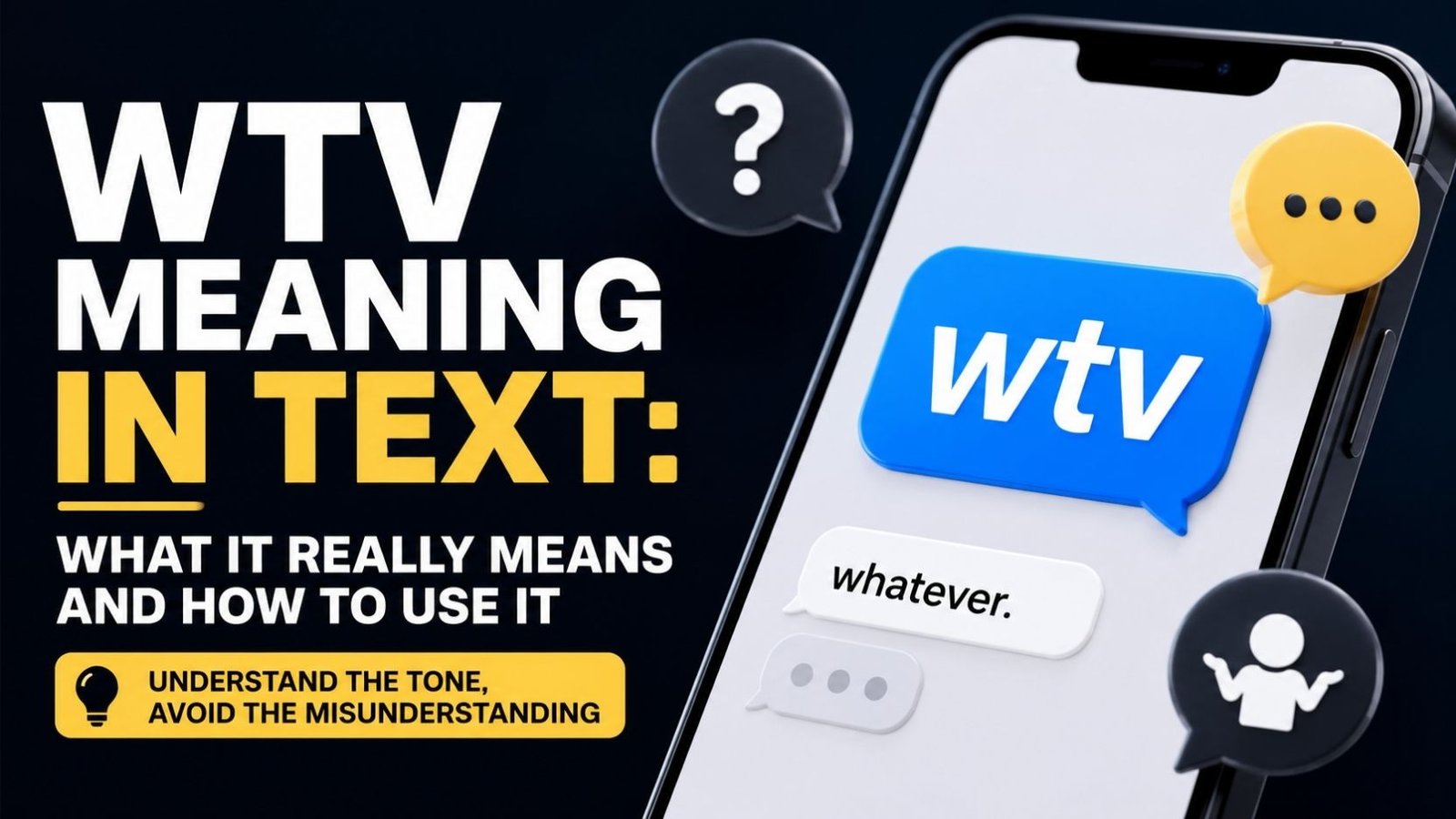
WTV means “whatever.” It is a texting abbreviation people use when they do not care much about a decision, when they want to end a topic, or when they are agreeing without much excitement. You will see it in text messages, Instagram DMs, Snapchat chats, and TikTok comments.
The word looks small, but it carries a lot of tone. WTV can sound relaxed, bored, annoyed, or even a little cold, depending on who sends it and how the conversation is going. Understanding that tone is the real key to reading this abbreviation correctly, so this guide breaks it down piece by piece.
What Does WTV Mean In Text?
WTV is short for “whatever.” People type it instead of the full word to save time and keystrokes, especially on mobile keyboards. The meaning stays close to the original word: a general sense of indifference or acceptance.
When someone texts “wtv,” they are usually saying one of these things:
- I do not have a strong preference.
- I am fine with any option you choose.
- I do not want to keep arguing about this.
- I am not that interested in this topic right now.
The exact meaning shifts with context. A friend replying “wtv” to “pizza or tacos tonight” is being easygoing. A partner replying “wtv” after a disagreement is usually signaling frustration. The letters stay the same, but the feeling behind them changes.
WTV Meaning In Text Message: The Core Definition
In a plain text message, WTV almost always maps back to “whatever.” There is no hidden second meaning that most people intend when they type it. What changes is the emotional weight attached to that one word.
Think of “whatever” in spoken conversation. Said with a shrug and a smile, it means “I really do not mind.” Said with a flat tone after a tense back and forth, it means “I am done talking about this.” WTV works the same way in writing, except the reader has to guess the tone from context alone, since there is no voice or face to read.
This is why the same three letters can feel completely different in two separate conversations.
WTV Meaning In Text Slang: How Gen Z And Millennials Use It
As slang, WTV fits into a larger family of casual texting abbreviations that shorten common phrases: “brb,” “idc,” “nvm,” and similar terms. It became popular as texting moved from full sentences to quick, low-effort replies.
In slang use, WTV often does more emotional work than the literal word “whatever” would in formal writing. People lean on it to:
- Close out a conversation without sounding harsh.
- Avoid picking a side in a small decision.
- Show they are not bothered by an outcome.
- Signal mild annoyance without starting a bigger argument.
It is common among teens and young adults, but plenty of older texters use it too, since it fits naturally into fast, informal messaging.
Table: WTV In Different Everyday Situations
| Situation | Example Text | Likely Meaning |
| Choosing plans | “Movie or dinner? Wtv, you pick” | Genuine flexibility, no preference |
| After an argument | “Fine, wtv” | Frustration, wanting to stop the conversation |
| Casual agreement | “Wtv works for me” | Easygoing agreement |
| Ending small talk | “Cool, wtv, talk later” | Low investment in the topic, not necessarily rude |
| Passive dismissal | “Wtv you say” | Sarcasm or mild irritation |
This table shows the same word doing very different jobs depending on the sentence around it. Reading WTV in isolation, without context, is where most misunderstandings start.
Is WTV Rude? Reading The Tone Correctly
WTV is not automatically rude. On its own, it is a neutral abbreviation for “whatever.” Whether it feels dismissive depends on:
- The relationship between the two people texting.
- What was said right before the reply.
- Whether other warm signals are present, like emojis or a follow-up message.
- The general texting habits of the person sending it.
A friend who always types short, low-effort replies is probably not being rude when they send “wtv.” Someone who normally writes full sentences and suddenly switches to “wtv” after a tense exchange is likely signaling annoyance.
💡 Tip: If you are unsure how a “wtv” was meant, it is usually fine to ask directly. A simple “wait, are you annoyed?” clears up more confusion than trying to decode one word alone.
WTV Meaning In Text From A Guy
When a guy sends “wtv,” the meaning generally follows the same pattern as general usage, but people often search this specifically because tone confusion feels more personal in dating or relationship contexts.
Common interpretations include:
- He genuinely does not have a preference on the topic.
- He is a little annoyed but does not want to escalate things.
- He is being brief because he is busy, not because he is upset.
- He is pulling back slightly from the conversation.
There is no single rule that applies to every guy or every conversation. The surrounding messages, his usual texting style, and the topic being discussed matter more than the word itself.
WTV Meaning In Text From A Girl
The same logic applies here. When a girl sends “wtv,” it can mean easy agreement, mild frustration, or simple disinterest in continuing a specific topic. Gender does not change what the abbreviation stands for. What matters is the pattern of the conversation, not who typed the message.
If you are trying to figure out whether a “wtv” was warm or cold, look at the messages sent right before and after it, along with whether the person kept texting normally afterward.
Its WTV Meaning In Text
“Its wtv” (often written without the apostrophe as “its wtv”) is a shortened way of saying “it’s whatever,” meaning the situation does not really matter or is not worth stressing over. People use this phrase to downplay something, whether they truly feel that way or are pretending not to care.
Example:
- A: “Sorry I forgot to text back yesterday.”
- B: “Its wtv, no worries.”
Here, “its wtv” softens the situation and signals that no apology is needed. In a different context, the same phrase can carry a flatter, more resigned tone, closer to “it doesn’t matter anymore.”
WTV Meaning On Instagram
On Instagram, WTV shows up in comments, direct messages, and story replies. The meaning does not change from standard texting slang. It still means “whatever,” used to show indifference, casual agreement, or a quick, low-effort reaction to a post or message.
Because Instagram conversations are often fast and casual, short slang like WTV fits naturally into that rhythm. A comment reply of “wtv lol” usually reads as playful rather than serious, especially when paired with a laughing reaction.
WTV Meaning On Snapchat
Snapchat conversations disappear quickly and tend to be even more casual than texting or Instagram DMs. WTV keeps its core meaning of “whatever” here as well.
Because Snapchat is built around speed, users often lean on very short replies like “wtv” simply to keep the conversation moving without much thought. This does not always signal disinterest in the person, just in that specific message or topic.
WTV Meaning On TikTok
On TikTok, WTV appears in comments and captions the same way it does elsewhere: as a shorthand for “whatever.” It often shows up in reaction to a video or another comment, expressing a shrug-like attitude toward whatever is being discussed.
Because TikTok comment sections move fast and favor short, punchy replies, abbreviations like WTV fit the platform’s casual tone well.
WTV Meaning In Urban Dictionary
User-submitted slang dictionaries generally list WTV as an abbreviation for “whatever,” used in texting and online chat to express indifference or a dismissive attitude. Since these dictionaries are written by everyday users rather than linguists, definitions can vary slightly in wording, but they consistently point back to the same core meaning: whatever.
It is worth remembering that crowd-sourced slang dictionaries reflect common usage rather than official language rules, so treat them as a general guide rather than a strict authority.
Down For WTV Meaning
“Down for wtv” means someone is open to any plan and does not have a strong preference. It is a casual way of saying “I’m up for anything.”
Example:
- A: “What do you want to do this weekend?”
- B: “Down for wtv, you choose.”
This phrase leans positive and easygoing almost every time, unlike a standalone “wtv,” which can carry more mixed tones depending on context.
Grammar: What Part Of Speech Is WTV?
WTV is an abbreviation, not a standard part of speech on its own. It stands in for the word “whatever,” which itself can function as several different parts of speech depending on the sentence:
- Pronoun: “Whatever you decide is fine.” (referring to an unspecified thing)
- Adjective: “Whatever plan works for you.” (modifying “plan”)
- Interjection: “Whatever!” (used alone to express indifference)
Since WTV is texting shorthand, it usually plays the interjection or pronoun role in casual sentences, standing in as a quick, standalone reaction.
How To Use WTV In A Sentence
Because WTV is informal, it fits best in casual writing: text messages, social media comments, and chats with friends. It does not belong in formal writing, professional emails, or academic work.
Examples of natural use:
- “Pizza or sushi? Wtv, I’m easy.”
- “He said wtv when I asked if he was upset.”
- “Wtv happens, happens.”
- “I’m down for wtv this weekend.”
Notice that WTV can stand alone as a full reply, sit inside a sentence, or follow a comma the way “whatever” would in spoken English.
Common Mistakes With WTV
❌ Incorrect: Using WTV in a formal email or professional message.
✅ Correct: “I’m flexible on the meeting time, whichever works best for you.”
Formal contexts call for the full word “whatever,” or a more polished phrase altogether, since WTV reads as too casual for professional settings.
❌ Incorrect: Assuming WTV always means someone is upset.
✅ Correct: Reading the full conversation for tone before deciding it signals frustration.
Many readers jump straight to “they’re mad at me” the moment they see “wtv.” As shown throughout this guide, that is only one of several possible meanings.
❌ Incorrect: Confusing WTV with unrelated abbreviations like WTF or WYD.
✅ Correct: Recognizing that WTV means “whatever,” while WTF and WYD carry entirely different meanings (“what the …” and “what are you doing”).
WTV Meaning In Medical Or Other Non-Slang Contexts
Outside of texting, “WTV” is not a standard recognized medical abbreviation. If you encounter “WTV” in a medical document or clinical note, it is best treated as either a typo, a facility-specific shorthand, or an unrelated acronym rather than an established, widely recognized medical term. When accuracy matters, such as in health records, always confirm the intended meaning directly with the source rather than assuming it matches the texting slang sense of “whatever.”
Similar Words And Related Slang
| Abbreviation | Meaning | How It Differs From WTV |
| IDC | I don’t care | Stronger and more direct than wtv, less room for a soft or playful tone |
| NVM | Never mind | Used to drop a topic entirely, not just show indifference |
| WBU | What about you | A question, not a statement of indifference |
| K | Okay | A short acknowledgment, without the “I don’t mind either way” feeling of wtv |
| WTVR | Whatever, stretched out slightly | Same core meaning as wtv, sometimes used for emphasis or a slightly playful tone |
WTV sits in a middle ground: softer than “idc,” more expressive than a plain “k,” and more open-ended than “nvm.”
Origin Of WTV
WTV grew out of the broader shift toward text abbreviations that began with the rise of SMS messaging in the early 2000s. As phone keyboards made typing slower and character limits shaped early texting habits, users shortened common words and phrases to save time. “Whatever” was already a frequent, casual word in spoken English, so it was a natural candidate for shortening once texting culture took off.
Since then, WTV has carried over into instant messaging apps, social media comments, and platforms like Snapchat, Instagram, and TikTok, keeping its original meaning intact.
Frequently Asked Questions
What does WTV mean in text?
WTV is short for “whatever.” It shows indifference, casual agreement, or a wish to end a topic.
Is WTV rude?
Not automatically. Its tone depends on the conversation, the relationship, and what was said right before it.
What does WTV mean from a guy or a girl?
The meaning does not change by gender. It can signal easy agreement, mild frustration, or simple disinterest in the topic, depending on context.
What does its WTV mean in text?
“Its wtv” means “it’s whatever,” used to say a situation does not matter much or is not worth stressing over.
Is WTV a noun or a verb?
WTV is an abbreviation for “whatever,” which usually functions as a pronoun or interjection in casual sentences, not a noun or verb.
What is the difference between WTV and IDC?
WTV leans softer and more flexible, closer to “I don’t mind either way.” IDC (“I don’t care”) tends to sound more direct and sometimes more blunt.
What does down for WTV mean?
It means someone is open to any plan, similar to saying “I’m up for anything.”
Does WTV mean the same thing on Snapchat, Instagram, and TikTok?
Yes, the core meaning stays “whatever” across platforms. The tone still depends on the specific conversation.
Can WTV be used in formal writing?
No. It belongs in casual texting and social media, not emails, reports, or professional communication.
Is WTV the same as WTVR?
Yes, WTVR is simply a stretched-out version of WTV, with the same meaning of “whatever.”
Final Thoughts
WTV is a simple abbreviation with a simple root: “whatever.” What makes it tricky is not the definition itself, but the tone attached to it, which can shift from relaxed and easygoing to short and frustrated depending on the conversation around it.
The best way to read WTV correctly is to look at the full exchange, not just the three letters. Once you get comfortable checking context, tone, and the relationship between the people texting, this small piece of slang stops feeling confusing and starts feeling like exactly what it is: a quick, casual way of saying “whatever.”

Anaya Raza is the author of Mean Xpert, a trusted resource for clear and easy-to-understand explanations of meanings, words, slang, and names. With 4 years of experience, she focuses on providing accurate, useful, and reader-friendly information that helps readers understand the meaning behind everyday words, phrases, and names.