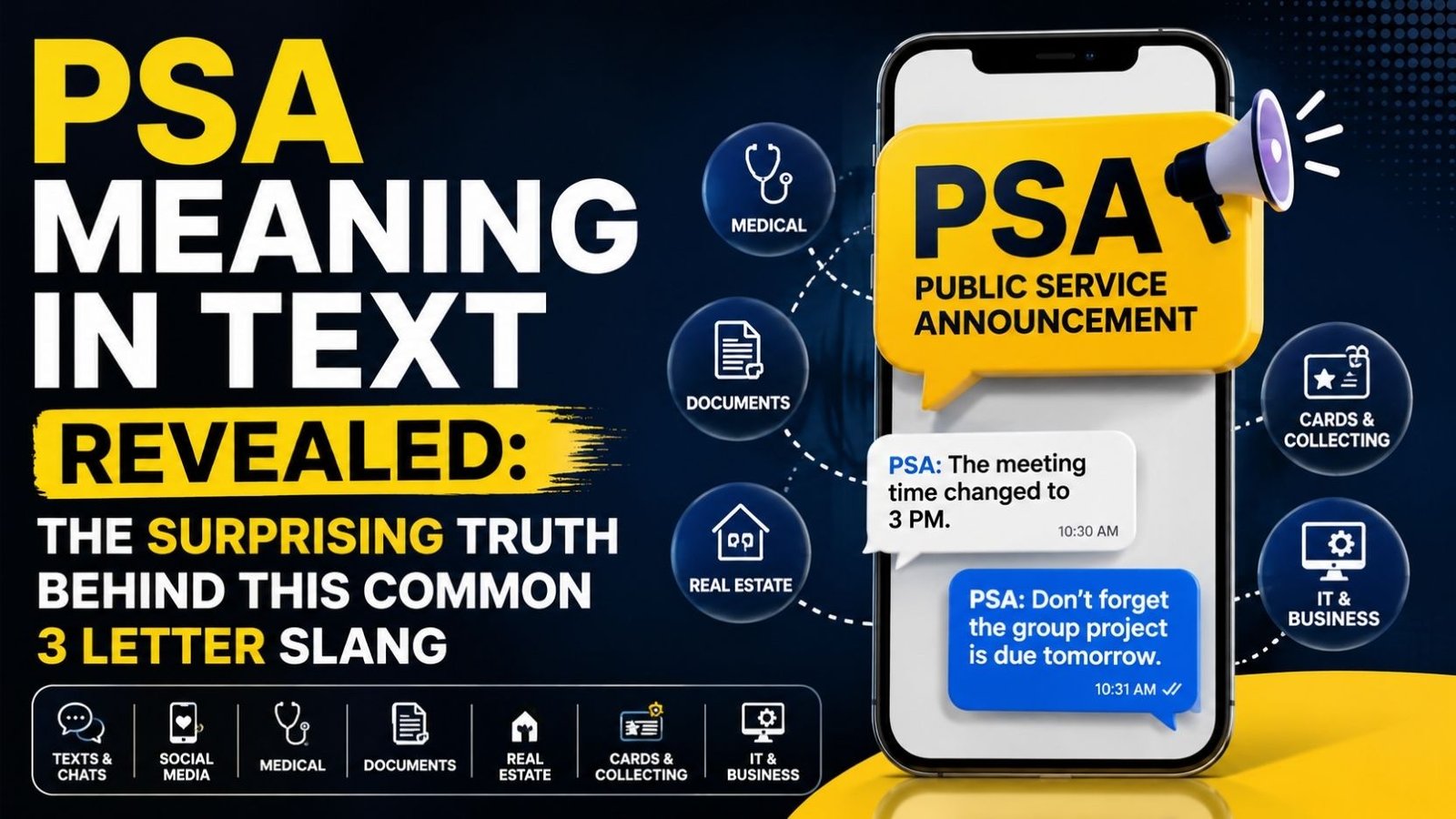
PSA meaning in text is simple. It stands for “public service announcement.” People use it to signal that they are about to share something important, useful, or worth everyone’s attention. It works in group chats, on social media, and even in casual conversation with friends.
The reason PSA shows up so often today is that it borrows the weight of a real announcement. It makes a small message feel bigger, more serious, or more worth reading. Understanding this shift helps you read tone correctly and use PSA the right way in your own messages.
What Does PSA Mean In A Text Message?
In a text message, PSA means “public service announcement.” The sender uses it to introduce information they think the reader needs to know right away.
It usually comes at the start of a message. Think of it as a verbal flag. It tells the reader: pay attention, this matters.
Here are a few common examples of how this looks in real texts.
- PSA: the coffee shop on Main Street closes early on Sundays.
- PSA: don’t forget the group project is due tomorrow.
- PSA: that new phone update drains your battery fast.
Each example follows the same pattern. The word PSA comes first, followed by a colon, followed by the actual information. This structure is now so common that many readers recognize it instantly, even without thinking about the original meaning.
Quick Definition Box
| Term | Meaning |
| PSA | Public service announcement |
| Used for | Sharing something important, useful, or worth knowing |
| Tone | Can be serious, casual, or joking depending on context |
| Common in | Texts, group chats, social media captions, emails |
PSA Meaning In Chat And Group Messages
PSA meaning in chat works the same way it does in a text message, but the audience is usually bigger. A group chat has many people reading at once, so PSA works well to grab shared attention.
In a group setting, PSA often introduces a reminder, a warning, or an update that affects everyone in the conversation. It saves the sender from writing “hey everyone, please read this” every time.
Some natural examples:
- PSA: the meeting time changed to 3 PM.
- PSA: please don’t reply-all to this thread.
- PSA: someone left their jacket at the last hangout.
Because group chats move fast, PSA acts like a small headline. It helps important messages stand out from casual back-and-forth chatter.
PSA Meaning Slang: How It Evolved Beyond Its Original Use
PSA meaning slang has moved far from its formal, broadcast-based origin. Traditionally, a public service announcement was a professional message aired on television or radio to inform the public about safety, health, or civic matters. In today’s texting culture, social media, and online conversations, PSA now serves multiple purposes, from grabbing attention to sharing updates, warning friends about potential issues, or making playful announcements.
This shift happened gradually. As internet culture grew more informal, people borrowed the seriousness of official PSAs and applied it to everyday situations. Saying “PSA” before a message about a sale, a mistake, or a funny observation gives that message a mock-official tone.
On the surface, PSA comes from old television and radio announcements, the kind that would interrupt a program to share something important about health or community safety. Online, most people are not thinking about that history at all. When someone types PSA today, they are basically saying, “what I’m about to tell you actually matters.”
PSA Meaning Slang From A Girl Or In Casual Conversation
There is no different meaning of PSA based on gender. When PSA appears in a text from a friend, a partner, or anyone in casual conversation, it still means “public service announcement.” The tone, however, can shift.
In casual or flirty texting, PSA sometimes introduces something playful rather than truly urgent. For example:
- PSA: I make really good pasta, just so you know.
- PSA: I’m stealing your hoodie.
These uses are light-hearted. The word PSA is doing less “official warning” work and more “cute, exaggerated announcement” work. Context and the relationship between the two people usually make the tone obvious.
PSA Meaning On Social Media (Instagram, TikTok, Twitter, Reddit)
PSA stands for “public service announcement” on social media as well. It’s used to grab attention before sharing important information, helpful tips, or urgent warnings with followers.
On platforms like Instagram, TikTok, and X (formerly Twitter), PSA often appears at the start of a caption or a short video. Creators use it to introduce a tip, a warning, or a piece of advice they want people to take seriously, even if the topic itself is small or funny.
On Reddit, PSA posts usually address a whole community at once. A user might post a PSA to stop repeated questions, warn about a scam, or correct a common misunderstanding shared by many members of the group.
| Platform | Typical PSA Use |
| Lifestyle tips, warnings, product alerts | |
| TikTok | Quick advice videos, trend warnings, humorous “announcements” |
| Twitter/X | Short public alerts, corrections, reminders |
| Community-wide notices, scam warnings, repeated-question reminders |
Why People Say “PSA” Instead Of Just Sharing Information
It’s worth asking why a three-letter acronym became so popular when people could simply share the information directly. The answer has to do with tone and attention, not just efficiency.
Saying “PSA” does a few things at once:
- It signals importance before the reader even sees the content.
- It borrows the credibility of an official announcement, even for small topics.
- It creates a light sense of humor when used for trivial or funny information.
- It groups the message as relevant to everyone reading, not just one person.
This is why PSA works so well in group settings. A plain statement like “the printer is broken” can get lost in a busy chat. “PSA: the printer is broken, use the one on the second floor” reads as a message worth stopping to notice.
PSA Meaning In Email And Business Communication
PSA meaning business contexts leans more formal than texting slang, but it is still less common in professional emails than in casual chat. When PSA does appear in a workplace email, it usually introduces a reminder or policy update meant for a whole team.
Example:
- PSA: the office will be closed on Friday for maintenance.
- PSA: please submit expense reports by the end of the week.
Even so, many professional writers prefer plainer alternatives like “reminder,” “heads up,” or “please note” in formal emails. PSA can come across as slightly informal, so it fits better in internal team chats than in messages to clients or senior leadership.
💡 Tip: If you are unsure whether PSA fits the tone of a workplace message, “quick reminder” is usually a safer, more neutral choice.
Is PSA Formal Or Informal?
PSA sits mostly on the informal side of language. It began as a formal broadcasting term, but its everyday use today, especially in texting and social media, is casual.
That said, PSA is not slang that would sound rude or inappropriate in a professional setting. It simply feels more relaxed than terms like “notice” or “announcement.” Many workplaces use PSA comfortably in internal messaging tools like Slack, even if they avoid it in formal client emails.
PSA Meaning In Medical Contexts: Prostate-Specific Antigen
Outside of texting and slang, PSA has an important and completely different meaning in medicine. In healthcare, PSA stands for prostate-specific antigen. This is a protein produced by the prostate gland, and doctors measure its level in the blood through a PSA test.
There is no single “normal” prostate-specific antigen level, since what counts as low for one man may be considered high for another. Historically, doctors treated a PSA reading below 4 nanograms per milliliter of blood as within the normal range, though later research shows that many factors, including age and family history, can affect what is truly normal for an individual.
What Does A High PSA Mean?
A high PSA level does not automatically mean cancer, but it does raise the chance that further testing is needed. Men with a PSA level below 4.0 have roughly a 15 percent chance of having prostate cancer, while a reading between 4.0 and 10.0 raises that chance to around 25 percent. A PSA level of 10 or higher points to a substantially greater risk, generally more than 50 percent.
What Does A Low PSA Mean?
A low PSA level generally suggests a lower likelihood of prostate cancer, but it does not rule it out completely. It is possible to have prostate cancer even when a PSA test comes back within a normal range, since some types of prostate cancer do not raise PSA levels. This is why doctors often combine PSA results with other exams rather than relying on the number alone.
| PSA Level (ng/mL) | General Risk Level |
| Below 4.0 | Lower risk, though not zero |
| 4.0 to 10.0 | Borderline, increased risk |
| Above 10.0 | Higher risk, further testing usually needed |
⚠️ Common Mistake: Treating a single PSA number as a diagnosis. A PSA test result is a screening tool, not a final answer. Only a doctor can interpret it alongside other exams and personal health history.
Why Doctors Order A PSA Test
A PSA test is a simple blood draw, usually ordered as part of a routine checkup for men over a certain age, or when a doctor wants to monitor a patient who has already been treated for prostate cancer. Because PSA levels can rise for reasons other than cancer, including infection, an enlarged prostate, or recent physical activity, doctors typically look at the trend over time rather than a single reading.
If a PSA level looks unusual, the next step is often a repeat test, followed by additional exams such as a physical exam or imaging, before any decision is made about a biopsy. This layered approach is why a single high or low PSA meaning should never be treated as a full diagnosis on its own.
PSA Meaning In The Philippines: Philippine Statistics Authority
In the Philippines, PSA has a completely different and very common meaning. It stands for the Philippine Statistics Authority. The Philippine Statistics Authority is the central statistical authority of the Philippine government, formed by merging several former agencies, including the National Statistics Office.
This is why Filipino birth certificates, marriage certificates, death certificates, and Certificates of No Marriage are commonly called “PSA certificates.” A PSA birth certificate is an official civil registry document containing a person’s full name, date and time of birth, place of birth, sex, nationality, and parents’ names, printed on official security paper.
If you see “PSA meaning birth certificate” searched often, this is the context behind it. It has nothing to do with texting slang. It refers to an official government document required for passports, school enrollment, employment, and many other legal processes in the Philippines.
PSA Meaning In Pokemon Cards And Collecting
Collectors searching “PSA meaning cards” or “PSA meaning Pokemon” are usually asking about card grading, not texting slang. PSA, short for Professional Sports Authenticator, is a third-party company that grades the condition of trading cards on a numeric scale.
PSA grades cards on a 1 to 10 scale, where PSA 10 represents the highest possible grade, known as Gem Mint, and PSA 1 represents the lowest, known as Poor. Every card is judged on four main factors: centering, corners, edges, and surface condition.
What Does PSA 10 Mean?
A PSA 10, or “Gem Mint,” describes a virtually flawless card, generally requiring centering of 55/45 or better on both axes, four sharp corners, and no noticeable surface scratches or print defects. A PSA 9, by comparison, allows one minor flaw, such as a faint hairline or slightly looser centering.
This grading system matters because it directly affects resale value. A card graded PSA 10 can sell for significantly more than the same card graded PSA 9 or lower, especially for rare or vintage cards.
| PSA Grade | Common Name | General Condition |
| PSA 10 | Gem Mint | Virtually flawless |
| PSA 9 | Mint | One very minor flaw |
| PSA 8 | NM-MT | Minor wear, mostly unnoticeable to the eye |
| PSA 7 and below | Near Mint and lower | Visible wear or damage |
PSA Meaning In Real Estate
In real estate, PSA meaning is “purchase and sale agreement.” A purchase and sale agreement, also called a sales and purchase agreement or an agreement for purchase and sale, is a contract between a buyer and a seller of real estate, company stock, or other assets.
A PSA works like a preliminary agreement between buyer and seller, declaring the buyer’s intent to purchase and the seller’s intent to sell, though it does not finalize the sale on its own. It is a written legal document that lays out terms such as the closing date, contingencies, and the required earnest money deposit.
This is different from a final purchase agreement. A purchase and sale agreement outlines the specific terms and conditions of a transaction, while the purchase agreement is the final paperwork both parties sign to complete the sale.
PSA Meaning In Software And IT (RMM PSA)
In business technology, particularly for IT companies and managed service providers, PSA stands for professional services automation. Professional services automation is software designed to help professionals such as lawyers, auditors, and IT consultants manage projects, resources, and billable staff utilization for client work.
You will often see PSA paired with another term, RMM, which stands for remote monitoring and management. RMM is technology focused, allowing IT teams to monitor, maintain, and troubleshoot client devices remotely, while PSA manages workflows, billing, ticketing, and client contracts. Together, PSA and RMM streamline both the technical and administrative sides of running an IT services business, with RMM handling device monitoring and PSA automating tasks like invoicing, ticket resolution, and reporting.
This is the meaning behind searches like “RMM PSA meaning professional services automation.” It is a business software category, unrelated to texting or medicine.
PSA Meaning In Oxygen Plants And Industrial Gas Production
In an industrial or medical equipment context, PSA stands for pressure swing adsorption. Pressure swing adsorption is a technique used to separate gas species from a mixture, typically air, using materials that adsorb gases differently depending on pressure.
Pressure swing adsorption oxygen generating plants are a recognized source of medical-grade oxygen, which is essential medicine required across healthcare systems. These plants became especially well known during large-scale health emergencies, when hospitals needed a reliable, on-site way to produce oxygen without depending entirely on outside suppliers.
This meaning of PSA is technical and industry-specific. It has no connection to texting, real estate, or card grading, but it explains why searches like “PSA meaning oxygen gas plant” return very different results than “PSA meaning in text.”
PSA Meaning Overview: All Contexts Compared
Because PSA carries so many different meanings, context is everything. The table below summarizes the major meanings covered in this guide.
| Context | What PSA Stands For | Typical Use |
| Texting and chat | Public service announcement | Flagging important or useful information |
| Social media | Public service announcement | Grabbing attention before a tip or warning |
| Medical | Prostate-specific antigen | A blood test related to prostate health |
| Philippines | Philippine Statistics Authority | Government agency issuing civil documents |
| Card collecting | Professional Sports Authenticator | Grading the condition of trading cards |
| Real estate | Purchase and sale agreement | Contract between buyer and seller |
| IT and business software | Professional services automation | Software managing service business operations |
| Industrial and medical gas | Pressure swing adsorption | Process used to produce oxygen from air |
PSA vs Psalm vs PSAT: Avoiding Mix-Ups
Because these three terms look and sound similar in quick typing or autocorrect, it helps to separate them clearly.
| Term | What It Means | Example Context |
| PSA | Public service announcement, or one of the specialized meanings above | “PSA: the store closes early today.” |
| Psalm | A sacred song or poem, especially from the Book of Psalms in the Bible | “Psalm 23 is one of the most quoted passages in the Bible.” |
| PSAT | Preliminary SAT, a standardized practice test for American high school students | “She’s studying for the PSAT this fall.” |
These three words share no real connection beyond a passing resemblance in spelling. Autocorrect sometimes swaps one for another, so it is worth double-checking before sending a message, especially in a school or religious context where the mix-up would stand out.
Grammar: Is PSA A Noun, And How Do You Use It In A Sentence?
PSA functions as a noun. It refers to the announcement itself, or in slang use, to the act of sharing important information.
Because it is an acronym, PSA is almost always written in capital letters. It does not change form for plural or possessive use in casual writing, though formal writing may use “PSAs” for the plural.
Correct examples:
- This is just a quick PSA.
- I saw three PSAs about hurricane safety this week.
- Consider this your PSA for the day.
Incorrect examples to avoid:
❌ Incorrect: This is just a quick psa announcement, letting you know.
✅ Correct: This is just a quick PSA, letting you know.
The word “announcement” is already part of what PSA stands for, so pairing it with “PSA announcement” is technically redundant, similar to saying “ATM machine.” It is a common habit in casual speech, but tighter writing avoids it.
How To Pronounce PSA
PSA is pronounced by saying each letter individually: P, S, A. It is not pronounced as a single blended word.
In IPA, it can be represented as /ˌpiː ˌɛs ˈeɪ/. There is no British versus American difference in pronunciation, since it is read letter by letter in both varieties of English.
British English vs American English Usage
PSA as texting slang is far more common in American English than in British English. American social media and texting culture use it heavily, so most Americans recognize it instantly in a casual message. British English speakers use it less often, sometimes preferring alternatives like “heads up” or “please note” instead. When British users do use PSA, it is usually picked up through exposure to American internet culture rather than home-grown usage.
Origin Of PSA (Public Service Announcement)
The phrase “public service announcement” has roots that stretch back further than many people expect. The history of PSAs stretches back to the Civil War, when both sides used newspaper ads to sell war bonds, and continued through World War I with recruitment posters.
The modern idea of a public service announcement, a philanthropic use of broadcast airtime for a greater good, started in the United States in the 1940s, when stations set aside commercial or program time to support war efforts under the guidance of the War Advertising Council. The first radio public service announcement is often traced to World War II, when broadcasts promoted war bonds and recruiting efforts.
From there, PSAs grew into a permanent fixture of American radio and television, covering everything from road safety to anti-smoking campaigns. The internet-era slang meaning of PSA, used casually in texts and social posts, developed much later, as people began borrowing the phrase’s tone of importance for everyday messages.
Similar Words And Related Terms
Several words and phrases overlap with PSA in meaning or function, though each carries its own shade of tone.
| Term | Meaning | Difference From PSA |
| FYI | For your information | More neutral and professional, less attention-grabbing |
| Heads up | A warning or alert | More casual, often used before mildly negative news |
| Reminder | A note about something already known | Less dramatic, purely informational |
| Announcement | A formal statement | Broader in scope, not tied to public benefit |
| Notice | A formal alert, often written | More common in legal or official documents |
FYI tends to work better in professional emails when you want to sound neutral rather than urgent. PSA, by contrast, adds a bit of drama or emphasis, which is exactly why it took off in casual digital communication.
Common Mistakes People Make With PSA
Even though PSA is short and simple, a few small mistakes show up often in casual writing.
❌ Incorrect: PSA, everyone needs to see this.
✅ Correct: PSA: everyone needs to see this.
A colon after PSA is the standard, expected format. Leaving it out can make the sentence read awkwardly, especially in written text.
❌ Incorrect: Using PSA for something serious like a medical emergency.
✅ Correct: Save PSA for lighter reminders and general information; use direct, clear language for anything urgent or serious.
Because PSA can carry a playful tone online, using it for a genuine emergency can accidentally undercut the seriousness of the message.
❌ Incorrect: Confusing “PSA” with “psalm” or “PSAT” in quick typing.
✅ Correct: Double-check spelling, since PSA, psalm, and PSAT are unrelated terms that only look similar at a glance.
PSA Meaning In Text Funny Examples
PSA memes and jokes commonly use in text on social media are used for comedic effect. Instead of sharing real news, the “announcement” is exaggerated, silly, or self-deprecating.
Examples:
- PSA: I will not be answering texts until I’ve had coffee.
- PSA: my dog now believes he owns the couch.
- PSA: pineapple does belong on pizza, fight me.
This humorous use plays off the mismatch between the formal-sounding word PSA and the trivial content that follows. That contrast is part of what makes it funny.
Frequently Asked Questions
What does PSA mean in a text message?
PSA means “public service announcement.” In texting, it introduces information the sender thinks is important or useful for the reader to know.
Is PSA formal or informal in texting?
PSA is mostly informal in texting and social media, even though it originally comes from formal broadcast announcements.
What does PSA mean on social media?
On social media, PSA works the same way as in texting. It signals that a post contains a tip, warning, or piece of information worth paying attention to.
What is the difference between PSA and FYI?
PSA usually carries more emphasis and is aimed at a wider audience, while FYI is quieter, more neutral, and often used one-on-one.
What does PSA mean in medical terms?
In medicine, PSA stands for prostate-specific antigen, a protein measured through a blood test that helps assess prostate health.
What does a high PSA level mean?
A high PSA level increases the likelihood of prostate cancer but does not confirm it on its own. Doctors use it alongside other tests to make a diagnosis.
What does PSA mean on a birth certificate?
On a Philippine birth certificate, PSA stands for the Philippine Statistics Authority, the government agency responsible for issuing official civil registry documents.
What does PSA 10 mean for Pokemon cards?
PSA 10 means a card has received the highest possible grade, called Gem Mint, based on centering, corners, edges, and surface condition.
What does PSA mean in real estate?
In real estate, PSA stands for purchase and sale agreement, a legally binding contract that outlines the terms of a property transaction between buyer and seller.
Is PSA a noun?
Yes, PSA is a noun. It refers to the announcement itself, or in casual usage, to any message meant to inform or warn others.
Conclusion
PSA meaning in text almost always comes back to “public service announcement,” a phrase borrowed from formal broadcasting and reshaped into everyday digital language. In texts, group chats, and social media, it flags information the sender wants the reader to notice and take seriously, even when the message itself is small, funny, or lighthearted. Outside of texting, PSA carries entirely different meanings depending on the field, from prostate-specific antigen in medicine to purchase and sale agreement in real estate, and from the Philippine Statistics Authority to professional services automation in IT.
Knowing which meaning applies simply comes down to context. If you see PSA in a group chat or a caption, it is almost certainly the casual, attention-grabbing version. If you see it in a medical report, a Filipino document, a card-grading label, or a business software description, it points to one of the more specialized meanings covered in this guide. Either way, understanding both the slang and the technical sides of PSA meaning in text and beyond helps you read messages, documents, and conversations with real confidence.

Anaya Raza is the author of Mean Xpert, a trusted resource for clear and easy-to-understand explanations of meanings, words, slang, and names. With 4 years of experience, she focuses on providing accurate, useful, and reader-friendly information that helps readers understand the meaning behind everyday words, phrases, and names.